What Is Brand Identity and How to Build One That People Remember
A customer sees your logo.
Then they see your Instagram post.
Then they visit your website.
Then they receive a WhatsApp message from your team.
Then they see one of your advertisements a few days later.
Ideally, all of these experiences should feel like they belong to the same brand.
But many businesses don’t work that way.
The logo looks one way. The social media feels completely different. The website uses another tone. The advertisements make promises that the sales team communicates differently.
The business may have a good product. It may even have good marketing.
But something feels inconsistent.
That “something” is often a missing or poorly defined brand identity.
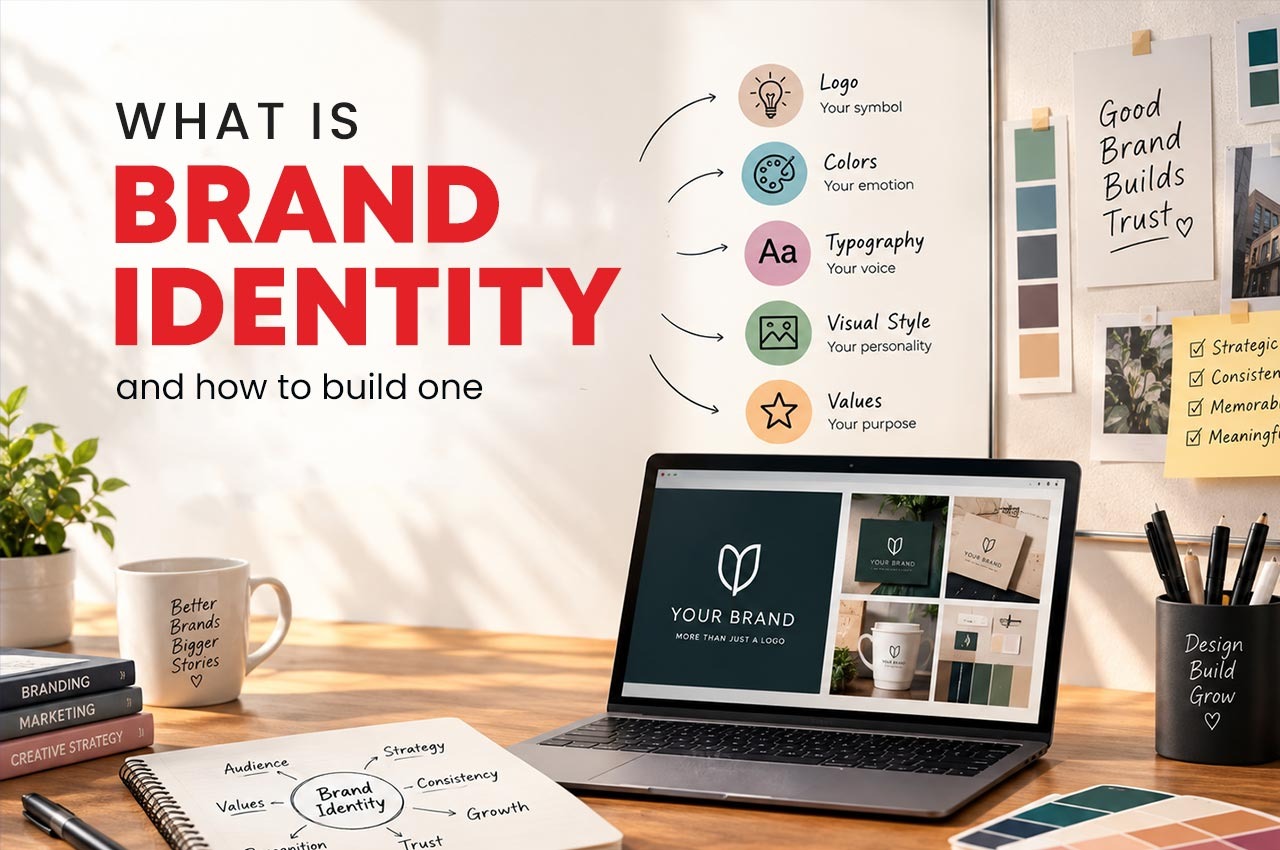
Brand identity is much more than a logo, colour palette or attractive packaging. It is the system of visual, verbal and emotional elements that tells people who your brand is, what it stands for, and what they can expect from it.
And in a crowded digital market, that consistency can make the difference between being noticed and being remembered.
What Is Brand Identity?
Brand identity is the way a business intentionally presents itself to its audience.
It includes the visible elements people recognize, such as:
- Logo
- Colours
- Typography
- Photography style
- Graphics
- Packaging
- Website design
But it also includes the less visible elements:
- Brand voice
- Personality
- Values
- Messaging
- Positioning
- Story
- Customer experience
Think about it this way.
Your logo is part of your identity.
Your identity is the complete picture.
A logo might help someone recognize you, but your messaging, design, tone and customer experience are what help them understand and remember you.
This is why two businesses can sell similar products but create completely different perceptions in the customer’s mind.
One may feel modern and energetic.
Another may feel traditional and dependable.
Another may feel premium and sophisticated.
The product category may be similar. The perception is not.
That perception is where branding starts doing real business work.
Brand Identity vs Brand Image: They Aren’t the Same
These two terms are often used interchangeably, but there is an important difference.
Brand identity is what you build and communicate.
Brand image is what people actually think and feel about you.
You can decide that your brand should be positioned as premium, professional and trustworthy.
But if your website looks outdated, your social media is inconsistent and your communication is unclear, customers may perceive the brand very differently.
That is why building a brand identity is not simply about deciding what you want people to think.
It is about consistently creating experiences that support that perception.
A strong identity gives you control over the story.
Your audience ultimately decides whether they believe it.
Why Brand Identity Matters More Than Ever
There are thousands of businesses competing for attention online.
Customers are exposed to advertisements, reels, websites, offers, influencers and promotional messages every day.
In that environment, being visible isn’t enough.
You need to be recognizable.
And being recognizable isn’t enough either.
You need to be meaningful.
A strong brand identity helps create that distinction.
When your visual style, messaging and personality remain consistent, customers don’t have to keep figuring out who you are.
They begin to recognize you.
Over time, recognition creates familiarity.
Familiarity can create trust.
And trust makes it easier for customers to choose you—especially when competing products or services look similar.
This is why branding shouldn’t be treated as something that only matters to large companies.
A local business, startup, B2B company, healthcare brand, e-commerce business or professional service provider can benefit from a strong identity.
Start With Strategy, Not Design
This is where many businesses get branding wrong.
They start with:
“Let’s make a logo.”
That’s usually too early.
Before a designer opens a design tool, the business needs to answer some important questions.
Who are you trying to reach?
Your brand cannot speak effectively to everyone.
A luxury interior brand, a children’s education brand and an industrial machinery manufacturer will naturally communicate differently.
Understanding your audience helps determine your language, visual style, content and positioning.
What problem do you solve?
Customers don’t buy your brand identity.
They buy the solution behind it.
Your identity should communicate the value you bring—not simply make the business look attractive.
Why should someone choose you?
This is your differentiation.
Maybe it’s expertise.
Maybe it’s convenience.
Maybe it’s innovation.
Maybe it’s craftsmanship.
Maybe it’s reliability.
Maybe it’s a completely different approach to solving the customer’s problem.
If you don’t define your difference, your audience may not see one.
What should people feel when they interact with you?
Should your brand feel:
- Trustworthy?
- Premium?
- Approachable?
- Innovative?
- Bold?
- Professional?
- Warm?
- Dependable?
This emotional direction influences almost every branding decision that follows.
Define Your Brand Positioning
Before building the visuals, decide where you want the brand to sit in the customer’s mind.
Consider two businesses selling the same category of product.
One says:
“Quality products at affordable prices.”
The other communicates:
“Thoughtfully designed products for people who care about the details.”
The second immediately creates a different perception.
That is positioning.
A strong brand positioning strategy answers:
Who are we?
Who are we for?
What do we offer?
Why are we different?
Why should customers believe us?
Without positioning, branding can become aesthetically pleasing but strategically empty.
Build a Distinct Brand Personality
If your brand were a person, how would it behave?
Would it be:
- Straightforward and confident?
- Friendly and conversational?
- Sophisticated and measured?
- Bold and energetic?
- Technical and authoritative?
This exercise may sound simple, but it has a practical purpose.
Brand personality helps teams make consistent decisions.
For example, a professional B2B brand probably shouldn’t suddenly start communicating like a casual meme page just because a particular trend is popular.
Likewise, a youth-focused brand may lose relevance if every piece of communication sounds overly formal.
Your personality should fit your audience and your positioning.
Create a Brand Voice People Can Recognize
Visual consistency gets a lot of attention.
Verbal consistency is often overlooked.
But consider how quickly people recognize brands from a particular style of communication.
Your brand voice determines how your business sounds across:
- Website copy
- Social media captions
- Advertisements
- Emails
- WhatsApp messages
- Sales presentations
- Videos
- Customer support
A brand shouldn’t sound sophisticated on its website and overly casual in every other interaction unless that difference is intentional.
Create clear guidelines around:
Words we use.
Words we avoid.
How formal we sound.
How we explain complicated ideas.
How we speak to customers.
A recognizable voice can become one of your strongest brand assets.
Then Build the Visual Identity
Once the strategic foundation is clear, visual branding becomes much easier.
Your visual identity design should translate your positioning into recognizable visual elements.
This typically includes:
Logo
Your logo should be distinctive, adaptable and appropriate for the brand.
It needs to work on a website, social media profile, packaging, presentation, signage and smaller digital applications.
A complicated logo that only looks good in one format isn’t particularly useful.
Colour Palette
Colours influence perception and recognition.
But choosing colours shouldn’t be based solely on personal preference.
Your palette should consider:
- Industry
- Target audience
- Competitor landscape
- Brand personality
- Digital usability
- Accessibility
Typography
Fonts communicate personality too.
A modern sans-serif, an elegant serif and a bold display typeface can create very different impressions.
More importantly, typography should remain consistent across brand touchpoints.
Photography and Graphics
Your identity should also define what kind of imagery represents your brand.
Do you use:
- Real photography?
- Product-focused visuals?
- Editorial imagery?
- Minimal graphics?
- Illustrations?
- Bold compositions?
These decisions create visual recognition over time.
Your Website Is Part of Your Brand Identity
A common mistake is treating branding and website development as separate projects.
They shouldn’t be.
Your website is often one of the first serious interactions a potential customer has with your business.
If your brand promises premium service but the website feels outdated, there is a disconnect.
If your brand is positioned as simple and customer-friendly but the website is complicated, the identity loses credibility.
A good website should therefore reflect:
Your positioning + visual identity + messaging + customer experience.
It should look like your brand, sound like your brand and behave like your brand.
Infinique Digital approaches website development around design, usability, responsiveness, speed and conversion rather than treating the website as simply an online brochure.
Social Media Should Look Like the Same Brand
Your Instagram or LinkedIn page should not feel like a completely different company from your website.
This doesn’t mean every post needs to look identical.
It means there should be recognizable patterns.
Your audience should gradually recognize:
- Your colours
- Typography
- Design language
- Photography style
- Content tone
- Messaging style
- Brand personality
This is especially important because social media is often where customers encounter a brand repeatedly.
One post may introduce you.
Another may educate them.
Another may demonstrate your expertise.
Another may show a customer experience.
Together, these create brand perception.
That is why social media branding should be treated as part of the larger brand identity—not simply as graphic design for Instagram.
Brand Identity Must Work in Advertising Too
Your paid advertisements are also brand touchpoints.
Imagine someone sees an advertisement today, visits your website tomorrow and sees a completely different visual language.
That inconsistency creates friction.
A strong digital brand identity should translate naturally into:
- Meta Ads
- Google Ads
- YouTube campaigns
- LinkedIn campaigns
- Display advertising
- Landing pages
This is where branding and performance marketing need to work together.
A performance campaign should generate results, but it should also strengthen brand recognition over time.
At Infinique Digital, performance marketing is built around understanding the product or service, audience, competitors and positioning before selecting platforms and campaign strategies.
That strategic foundation is important because good advertising shouldn’t just say, “Buy this.”
It should reinforce why this brand deserves consideration.
Consistency Does Not Mean Repetition
This is an important distinction.
Some businesses misunderstand brand consistency and make every post look exactly the same.
That creates monotony.
Consistency means the brand feels connected even when the content changes.
For example, your campaign for a product launch can look different from your educational content.
Your festival communication can look different from your corporate announcement.
Your Reel can look different from your website.
But the underlying identity should still be recognizable.
Think of it like a person’s wardrobe.
You don’t wear the same shirt every day.
But people can still recognize your personal style.
That’s what a mature brand identity should achieve.
Document Everything With Brand Guidelines
Once you’ve established the identity, document it.
A brand style guide or brand guidelines should ideally explain how the identity should be used.
It may include:
- Logo variations
- Logo spacing
- Colour codes
- Typography
- Font hierarchy
- Photography guidelines
- Graphic style
- Brand voice
- Messaging principles
- Social media design direction
- Do’s and don’ts
Why does this matter?
Because brands grow.
Different designers work on different campaigns.
New employees join.
Agencies change.
Marketing channels expand.
Without guidelines, your identity slowly starts drifting.
One shade becomes three.
One font becomes four.
The tone changes from professional to casual.
The brand gradually loses its visual and verbal consistency.
A brand guideline protects the identity you worked to build.
Your Brand Identity Should Evolve — But Not Disappear
Building an identity doesn’t mean freezing it forever.
Brands evolve.
Markets change.
Customers change.
Businesses introduce new products.
A visual identity that worked ten years ago may feel outdated today.
But evolution should be intentional.
There is a difference between a brand refresh and completely abandoning brand recognition.
A good refresh might modernize:
- Typography
- Colour palette
- Photography
- Logo treatment
- Website experience
- Content style
while retaining the core elements customers already associate with the brand.
The objective isn’t to look new for the sake of looking new.
It is to remain relevant without losing recognition.
Common Brand Identity Mistakes Businesses Make
Many branding problems aren’t caused by bad design.
They’re caused by poor strategic decisions.
Designing Before Defining
A beautiful logo cannot compensate for unclear positioning.
Copying Competitors
If your identity looks exactly like everyone else in your industry, customers have little reason to remember you.
Trying to Appeal to Everyone
A brand with no clear personality often becomes forgettable.
Changing Visuals Constantly
Every new designer shouldn’t create a completely new version of your brand.
Focusing Only on the Logo
Your identity exists across every customer touchpoint.
Ignoring the Customer Experience
You can call yourself premium, but the experience has to support that promise.
Treating Branding as a One-Time Project
Your brand identity needs to live consistently across your marketing and evolve as your business grows.
How to Know If Your Brand Identity Is Working
A strong identity isn’t successful simply because your team likes it.
Look at the market.
Ask:
Can customers recognize our content without seeing our logo?
Is our messaging consistent across platforms?
Can our sales team explain our positioning in one clear sentence?
Does our website look and sound like our social media?
Do customers understand what makes us different?
Does our visual identity match the price and quality we promise?
Do people remember us after seeing our communication?
These questions are far more useful than simply asking whether the logo “looks good.”
Brand Identity Is an Investment in Perception
A product can be copied.
A service can be replicated.
Competitors can match prices.
Features can become industry standards.
But a strong brand creates something harder to duplicate: a place in the customer’s mind.
That’s why businesses should stop looking at branding as an expense that only covers logos and design.
Your brand identity influences how customers perceive your:
- Quality
- Credibility
- Value
- Personality
- Expertise
- Trustworthiness
And those perceptions influence buying decisions.
In a crowded market, people don’t always choose the business with the most features.
They often choose the business they understand, remember and trust.
Building a Brand Identity Is Not Just a Design Exercise
A strong brand identity sits at the intersection of strategy, design, content and customer experience.
You need to know what you stand for before you decide how you look.
You need to understand your audience before deciding how you speak.
You need to understand your positioning before deciding what your campaigns should communicate.
And you need consistency to make all of those decisions feel like one brand.
That is where an experienced digital marketing partner can make a difference.
At Infinique Digital, branding is approached as part of a broader digital growth ecosystem. The agency combines brand design with social media marketing, SEO, performance marketing, Google Ads, video production and website development, helping businesses build a presence that is not only visually distinctive but also connected to their marketing goals.
Ready to Build a Brand People Remember?
If your business has grown but your branding hasn’t kept up, it may be time to step back and rethink the identity behind your marketing.
Maybe your logo needs a refresh.
Maybe your website no longer represents your positioning.
Maybe your social media looks different from your brand.
Or perhaps the bigger problem is that your business has never clearly defined what it wants to be known for.
Start there.
Because a strong brand isn’t built by asking:
“How can we make ourselves look better?”
It is built by asking:
“How do we want customers to perceive us — and what experience will make them believe it?”
If you’re ready to build a brand that is seen, heard and remembered, talk to Infinique Digital.
From brand design and content to social media, SEO, performance marketing and websites, Infinique can help bring the different pieces of your digital presence together into one stronger brand experience.
Build the identity. Strengthen the perception. Grow the brand.
Tags:
Share:
