
From Marketing Spend to Revenue: How to Identify Where Your Digital Growth Is Breaking Down
Every business wants better returns from digital marketing. More leads, more customers, higher sales, and sustainable revenue growth are the ultimate goals. Yet, many businesses continue to invest in Google Ads, Meta Ads, SEO, social media marketing, and content creation without understanding why their marketing spend is not translating into the expected results.
The problem is not always the advertising budget. Sometimes, the issue lies in audience targeting, website experience, lead quality, conversion tracking, or the sales process.
Digital marketing success is not measured by clicks, impressions, or followers alone. It depends on how effectively every marketing activity contributes to business growth.
At Infinique Digital, we believe that identifying performance gaps is the first step toward building a more profitable digital marketing strategy. By connecting marketing data with customer behaviour and business outcomes, brands can understand where growth is slowing down and what needs to change.
In this guide, we will explore how to identify the weak points in your digital marketing funnel, improve marketing ROI, and turn your marketing investment into measurable revenue.
1. Start by Understanding the Difference Between Marketing Activity and Business Growth
A campaign can generate thousands of impressions, hundreds of clicks, and dozens of leads without delivering meaningful revenue. This happens when businesses focus on marketing activity instead of the complete customer journey.
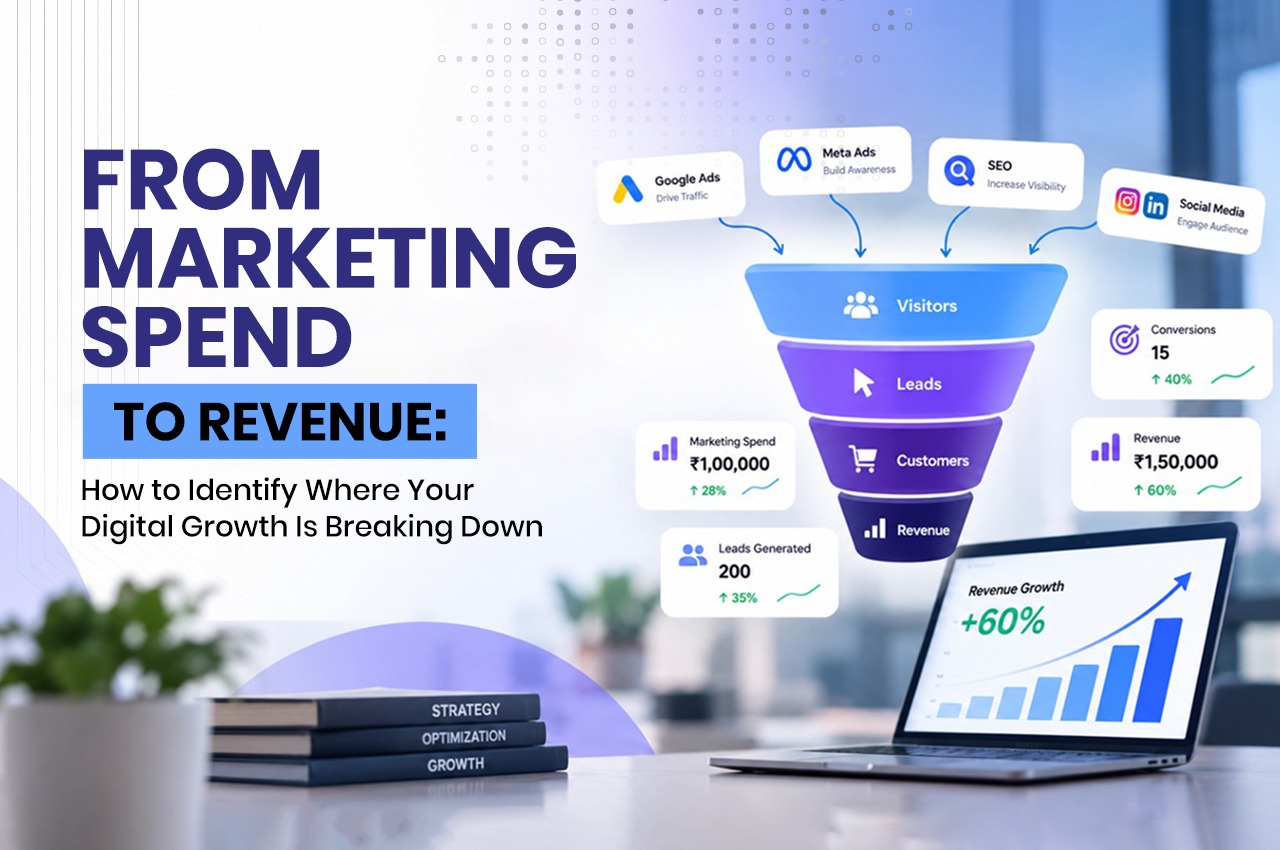
For example, consider a company that spends ₹1,00,000 on digital advertising and generates 200 leads. At first glance, the campaign appears successful. However, if only five leads become paying customers, the business may not achieve its revenue targets.
The real question is not simply how many leads the campaign generated. It is how many qualified prospects converted into customers and how much revenue those customers produced.
To evaluate digital marketing performance effectively, monitor these key metrics:
- Marketing spend: How much are you investing across different channels?
- Cost per lead (CPL): How much does it cost to generate a lead?
- Lead-to-customer conversion rate: What percentage of leads become paying customers?
- Customer acquisition cost (CAC): How much does it cost to acquire a new customer?
- Return on ad spend (ROAS): How much revenue is attributed to each rupee spent on advertising?
- Marketing return on investment (ROI): How profitable is your marketing investment after accounting for the relevant costs?
These metrics help you move beyond surface-level performance and understand whether your digital marketing strategy is supporting actual business growth.
2. Identify Where Your Digital Marketing Funnel Is Breaking Down
A digital marketing funnel represents the journey customers take from discovering your brand to making a purchase. Every stage influences the next, and a weakness at any point can reduce your overall marketing performance.
Stage 1: Low Visibility and Poor Audience Targeting
If your campaigns are not reaching the right audience, even the most creative advertisement may struggle to generate results.
Common warning signs include low impressions, irrelevant website traffic, low engagement, and limited enquiries from your target market.
The problem may be related to incorrect keyword selection, broad audience targeting, weak audience research, or choosing advertising platforms that do not align with your customers’ behaviour.
How to fix it:
- Research your target audience, customer needs, and purchase intent.
- Use relevant keywords in Google Ads campaigns.
- Refine Meta Ads targeting based on audience relevance and campaign objectives.
- Develop content around the problems your potential customers are actively trying to solve.
- Review campaign performance by audience segment, location, device, and traffic source.
A well-planned performance marketing strategy focuses on attracting potential customers who are more likely to convert, rather than simply increasing traffic.
Stage 2: High Traffic but Low Website Engagement
Generating website traffic is only the beginning. Visitors must also understand your offering, find relevant information, and feel confident enough to take the next step.
If users leave your website without exploring your services or products, your landing page experience may be creating friction.
Possible reasons include slow loading speed, confusing navigation, irrelevant landing page content, poor mobile usability, or a mismatch between your advertisement and website messaging.
How to fix it:
- Improve website speed and mobile responsiveness.
- Align landing page headlines with the advertisement that brought visitors there.
- Communicate your value proposition clearly.
- Add relevant testimonials, case studies, and trust signals.
- Make important information easy to find.
- Use clear calls to action, such as “Book a Consultation,” “Request a Quote,” or “Get Started.”
Your website should not simply inform visitors about your business. It should guide them toward a meaningful action.
Explore how website development and optimization can support a better user experience and conversion-focused digital presence.
Stage 3: Good Traffic but Poor Conversion Rates
Sometimes, your website attracts the right audience, but visitors still do not submit enquiries, book appointments, or complete purchases.
This indicates that your conversion rate optimization strategy may need attention.
A landing page may receive considerable traffic but generate very few leads because the offer is unclear, the form is too complicated, the call to action is weak, or visitors do not have enough information to make a decision.
How to fix it:
- Simplify lead forms and remove unnecessary fields.
- Test different headlines, page layouts, and calls to action.
- Make your offer specific and relevant to customer needs.
- Address common objections through FAQs and useful content.
- Reduce unnecessary steps between landing on the page and completing the desired action.
- Analyse conversion rates across devices and traffic sources.
Conversion rate optimization helps businesses generate more value from existing traffic, potentially reducing the need to increase advertising spend simply to acquire more visitors.
Stage 4: Leads Are Coming In, but Sales Are Not Happening
This is one of the most overlooked challenges in digital marketing.
Your campaigns may be generating enquiries at an attractive cost per lead, but if those enquiries do not convert into customers, your business may still struggle to achieve its revenue goals.
The underlying issue could be lead quality, slow follow-up, inconsistent sales communication, pricing concerns, or a mismatch between customer expectations and your offering.
How to fix it:
- Define what qualifies as a sales-ready lead.
- Review lead quality by campaign, keyword, and audience.
- Ensure sales teams follow up promptly.
- Track lead status from initial enquiry to final purchase.
- Use a CRM system to organise enquiries and monitor sales progress.
- Share feedback between sales and marketing teams to improve campaign targeting.
The goal is to optimise for qualified leads and actual customers, not just inexpensive enquiries.
When marketing and sales work together, businesses can identify which campaigns produce valuable customers and allocate budgets more effectively.
3. Fix Your Conversion Tracking Before Increasing Your Budget
You cannot improve what you cannot measure accurately.
Incomplete or incorrect conversion tracking can make successful campaigns appear unsuccessful and underperforming campaigns look profitable.
For example, if your analytics platform counts every button click as a conversion, your reports may show strong performance even when very few users complete meaningful actions.
Similarly, if purchases, phone calls, and qualified enquiries are not tracked properly, you may underestimate the value of certain marketing channels.
A reliable measurement setup should include:
- Google Analytics 4 (GA4) for website traffic and user behaviour analysis.
- Google Ads conversion tracking for relevant advertising outcomes.
- Meta Pixel and, where appropriate, Conversions API for measuring eligible website events.
- Form submissions, phone calls, purchases, and appointment bookings as relevant conversion events.
- CRM integration to connect enquiries with qualified opportunities and closed sales.
- Consistent campaign naming and UTM parameters for identifying traffic sources.
Tracking should also be tested regularly to identify duplicate events, missing conversions, and discrepancies between platforms.
Remember that advertising platforms may attribute conversions differently. Use consistent reporting rules and reconcile platform data with your actual business records wherever possible.
Accurate conversion tracking provides the foundation for smarter budget allocation, meaningful reporting, and sustainable digital growth.
4. Evaluate the Performance of Every Marketing Channel
Not every digital marketing channel contributes to revenue in the same way.
Google Ads may capture people who are actively searching for a product or service. Meta Ads can help businesses build awareness, generate demand, and reconnect with interested audiences. SEO can attract users through organic search, while content marketing supports customer education and trust.
The challenge is understanding how these channels work together.
Review your channel performance using the following framework:
| Marketing channel | Key metrics to monitor | Common performance gap |
|---|---|---|
| Google Ads | Conversion rate, cost per acquisition, qualified leads | Irrelevant search terms or weak landing pages |
| Meta Ads | Cost per qualified lead, conversion rate, creative performance | Audience mismatch or ineffective messaging |
| SEO | Organic traffic, keyword rankings, organic conversions | Traffic that does not match search intent |
| Social media marketing | Relevant engagement, website visits, assisted conversions | Content that attracts attention without encouraging action |
| Website and landing pages | Conversion rate, form completion, user behaviour | Poor user experience or unclear calls to action |
| Email and remarketing | Engagement, return visits, assisted and direct conversions | Weak follow-up or irrelevant communication |
The right metrics depend on your business model, sales cycle, and campaign objective.
For example, a B2B company with a long sales cycle may need to evaluate qualified opportunities and closed revenue over several months. An e-commerce business may place greater emphasis on purchases, average order value, and customer acquisition cost.
This is why a customised digital marketing strategy is more effective than judging every channel by the same metric.
Learn more about performance marketing services and Google Ads management to understand how data-driven campaigns can support measurable business objectives.
5. Connect Marketing Data With Actual Revenue
Marketing reports often focus on impressions, clicks, website sessions, and leads. However, these numbers do not tell the complete story unless they are connected to business outcomes.
Revenue-focused reporting should answer three important questions:
- Which marketing channels generate the most qualified leads?
- Which campaigns contribute to the highest number of paying customers?
- Which investments deliver sustainable returns after considering acquisition and operating costs?
Consider a simplified example.
Suppose two campaigns each generate 100 leads.
| Metric | Campaign A | Campaign B |
|---|---|---|
| Marketing spend | ₹20,000 | ₹30,000 |
| Leads generated | 100 | 100 |
| Cost per lead | ₹200 | ₹300 |
| Customers acquired | 5 | 15 |
| Revenue per customer | ₹10,000 | ₹10,000 |
| Total revenue | ₹50,000 | ₹1,50,000 |
| ROAS | 2.5x | 5x |
Although Campaign A generates cheaper leads, Campaign B produces more customers and higher revenue relative to its advertising spend.
This example demonstrates why optimising solely for cost per lead can be misleading.
Important: ROAS is not the same as profit. The figures above exclude product costs, salaries, agency fees, fulfilment expenses, and other business costs. A complete profitability assessment must account for the relevant expenses.
Businesses should connect advertising data with CRM and sales records wherever possible. This creates a clearer picture of which marketing activities contribute to revenue and which need improvement.
6. Use SEO and Content Marketing to Build Sustainable Growth
Paid advertising can provide visibility quickly, but long-term digital growth should not depend entirely on continuous ad spending.
Search engine optimization (SEO) and content marketing help businesses build organic visibility, answer customer questions, and establish authority within their industries.
However, publishing content alone is not enough. Content must address relevant search intent and guide readers toward useful next steps.
For example, a business searching for ways to improve digital marketing ROI may benefit from content covering:
- Digital marketing strategy and planning.
- Performance marketing and campaign optimization.
- Google Ads and Meta Ads management.
- Conversion rate optimization.
- Website development and user experience.
- Lead generation and customer acquisition.
- SEO services and organic traffic growth.
- Marketing analytics and revenue attribution.
These topics can attract relevant visitors when supported by appropriate keyword research, high-quality content, and a well-structured website.
To strengthen your SEO strategy:
- Target primary and related keywords naturally.
- Create useful, original content that satisfies search intent.
- Optimise title tags, meta descriptions, headings, and internal links.
- Improve technical SEO, website speed, and mobile usability.
- Link relevant blog posts to appropriate service pages.
- Track organic conversions alongside keyword rankings and traffic.
At Infinique Digital, SEO should be viewed as part of a broader growth strategy that connects search visibility with user experience, lead generation, and measurable business outcomes.
Explore our search engine optimization services to learn more about building a stronger organic digital presence.
7. Build a Continuous Optimization Process
Digital marketing performance can change as customer behaviour, competition, advertising costs, and market conditions evolve.
A campaign that performs well today may need adjustments tomorrow. That is why continuous monitoring and optimization should be part of your marketing process.
A practical review cycle can follow these steps:
Step 1: Audit your current performance. Review advertising accounts, website analytics, conversion tracking, landing pages, and sales data.
Step 2: Identify the biggest bottleneck. Determine whether the main issue is traffic quality, website engagement, conversion rates, lead quality, or sales follow-up.
Step 3: Prioritise improvements. Focus on changes that address the most significant performance gaps rather than making multiple unrelated changes at once.
Step 4: Test your assumptions. Run controlled experiments where practical, such as testing landing page messaging, audience segments, creative variations, or calls to action.
Step 5: Measure business impact. Compare qualified leads, customer acquisition cost, conversion rates, revenue, and profitability where data is available.
Step 6: Scale what works. Increase investment in proven opportunities while continuing to monitor performance and customer quality.
This process helps businesses make decisions based on evidence instead of assumptions.
8. Common Signs Your Digital Growth Strategy Needs Attention
If your business experiences any of the following challenges, it may be time to conduct a comprehensive digital marketing audit:
- Your advertising budget is increasing, but revenue remains stagnant.
- You receive website traffic but very few enquiries.
- Your campaigns generate leads, but sales teams report poor lead quality.
- You cannot clearly identify which marketing channel generates customers.
- Your cost per acquisition is increasing without a corresponding improvement in customer value.
- Your SEO rankings improve, but organic enquiries remain low.
- Your reporting focuses on clicks and impressions rather than business results.
- Your website experience does not match the expectations created by your advertisements.
These issues do not necessarily mean your marketing strategy has failed. They indicate that one or more stages of the customer journey may need closer examination.
Identifying the root cause allows you to make targeted improvements instead of simply spending more money.
Conclusion: Turn Digital Marketing Spend Into Measurable Business Growth
Sustainable digital growth does not come from increasing marketing budgets blindly. It comes from understanding how each stage of your marketing funnel contributes to customer acquisition, conversions, and revenue.
When you identify where performance breaks down, you can improve audience targeting, optimise landing pages, strengthen conversion tracking, enhance lead quality, and make better investment decisions.
The most effective digital marketing strategies combine creativity, data, technology, and a clear understanding of customer behaviour. Every campaign should have a defined purpose, every conversion should be measured accurately, and every performance report should help you make a better business decision.
At Infinique Digital, we help brands strengthen their online presence through performance marketing, Google Ads, SEO, social media marketing, website development, and creative digital solutions. Our focus is on building strategies that connect marketing activities with meaningful business outcomes.
If your business is investing in digital marketing but struggling to understand where growth is getting stuck, the first step is to identify the gaps and build a strategy around measurable results.
Ready to understand what is holding back your digital growth?
Visit Infinique Digital to explore our digital marketing solutions and discuss a strategy aligned with your business goals.
Frequently Asked Questions (FAQs)
1. How can I identify where my digital marketing strategy is failing?
Start by reviewing the complete customer journey, from audience reach and website traffic to conversions, qualified leads, and sales. Analyse metrics such as conversion rate, cost per lead, customer acquisition cost, and revenue by marketing channel to identify the weakest stage.
2. Why is my business spending on digital marketing but not generating enough revenue?
Possible reasons include poor audience targeting, low-quality leads, weak landing pages, inaccurate conversion tracking, ineffective sales follow-up, or an offer that does not match customer needs. A structured digital marketing audit can help identify the primary issue.
3. What is the difference between ROAS and marketing ROI?
Return on ad spend (ROAS) measures the revenue attributed to advertising relative to advertising expenditure. Marketing ROI evaluates the financial return from marketing after accounting for relevant costs. ROAS indicates advertising efficiency, while ROI provides a broader view of profitability.
4. Which digital marketing metrics should businesses track?
Important metrics include conversion rate, cost per lead, qualified lead rate, customer acquisition cost, revenue by channel, ROAS, marketing ROI, and customer lifetime value. The most relevant metrics depend on your business goals and sales cycle.
5. How can conversion rate optimization improve marketing performance?
Conversion rate optimization identifies and reduces friction in the customer journey. Improving landing page messaging, website speed, mobile usability, forms, trust signals, and calls to action can help convert a higher proportion of relevant visitors into leads or customers.
6. How does Infinique Digital help businesses improve digital marketing performance?
Infinique Digital offers performance marketing, Google Ads, SEO, social media marketing, website development, and other digital solutions. These services can help businesses improve online visibility, attract relevant audiences, optimise customer journeys, and measure marketing performance against defined business objectives.
About Infinique Digital
Infinique Digital is a digital marketing agency offering performance marketing, search engine optimization, Google Ads, social media marketing, website development, brand design, and video production. The agency helps businesses build a stronger digital presence through creative strategies and data-driven marketing solutions.
Website: https://infiniquedigital.com/
Tags:
Share:
